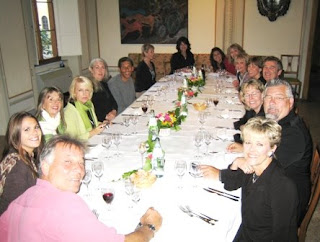
I am sitting on the plane en route back to the U.S. after another absolutely wonderful stay in Tuscany thinking to myself “how can I be so lucky”? I believe a large part of my good fortune can be accredited to learning about Il Borgo Villa di Bossi Pucci. Since I first entered through the grand gates last year, I (and everyone I bring here) have been treated with such good
  care. The apartments are simple and elegantly furnished with full living rooms and breakfast kitchens. Each building is restored to reveal its original typical Tuscan architecture. The views from the terraces in the 2 bedroom villas are stunning. I must admit I spent a great deal of time here admiring it all during my stay. The fog rolling down into the valley in the morning, the late afternoon cloud burst and thunderstorms, and the sunset (after 9pm in June) turning the valley to a gold and green paradise is as much a part of the holiday as is the trips to all the charming hill towns and restaurants.

The owner of the estate is a former CEO of Hilton International and American Express which helps to explain the top notch service and quality accommodations. Daily management of the property is under the capable hands of Alessandro Guerrieri. He, his wife Julia and their two sons all live on the estate. On a quiet afternoon in the summer, you can catch a glimpse of the boys playing soccer in one of the many grassy fields surrounding the estate. On special occasions, the large central courtyard plays host to classical concerts with local musicians and other such venues. The pool boasts the same fantastic views as the 2 bedroom villas with Poppiano Castle to the left and Montespertoli in the direct distance just past the vineyards and olive groves. Walking paths and quiet country roads lead in all directions from here taking you further into a Tuscan dream.
 surrounding the estate. On special occasions, the large central courtyard plays host to classical concerts with local musicians and other such venues. The pool boasts the same fantastic views as the 2 bedroom villas with Poppiano Castle to the left and Montespertoli in the direct distance just past the vineyards and olive groves. Walking paths and quiet country roads lead in all directions from here taking you further into a Tuscan dream.
The landscaping is abound with rosemary and roses, terra cotta pots brimming with blossoms  and of course, lots of olive trees and cypress. There is a little ancient chapel on property tucked away in a small wooded area just past the pool. It was very common for larger estates to all have their own chapel centuries ago. Just below the pool, a grassy pathway leads to the small town of Montagnana. Here there is the general store, (alimentari) a wonderful pizzeria, un ristorante, café, hair salon, gas station, post office, and real estate office. I could not resist taking a look at the few homes and apartments for sale, after all, this is a slice of paradise. Many of the apartments in Il Borgo are for sale as well if you are like me and would like this to be a more permanent holiday. In the meantime, staying at Il Borgo and participating in the Lessons of Tuscany program is the next best way to experience all the splendors of Tuscany.
 and of course, lots of olive trees and cypress. There is a little ancient chapel on property tucked away in a small wooded area just past the pool. It was very common for larger estates to all have their own chapel centuries ago. Just below the pool, a grassy pathway leads to the small town of Montagnana. Here there is the general store, (alimentari) a wonderful pizzeria, un ristorante, café, hair salon, gas station, post office, and real estate office. I could not resist taking a look at the few homes and apartments for sale, after all, this is a slice of paradise. Many of the apartments in Il Borgo are for sale as well if you are like me and would like this to be a more permanent holiday. In the meantime, staying at Il Borgo and participating in the Lessons of Tuscany program is the next best way to experience all the splendors of Tuscany.

 Just a few kilometers from Il Borgo is a ceramics shop … well, more like a ceramics production facility, or even a ceramics warehouse. Simply put, it's a large building housing many beautiful ceramics, a grand showroom and stations where the artist paint. The driveway was quite difficult to find – there was no sign. Anselmo, the town it is in is not even on most maps. We entered through the garage door. Immediately upon entering, we were in front of large shelves full of every kind of ceramics you can imagine - Large platters, plates and pitchers of every shape, size and design. Whichever pattern you liked, you could get every piece to


 Gimignano stopping at a small winery along the way to sample the well known Vernaccia, a white wine which is only produced in and around Siena. Arriving in San Gimignano is like arriving on a movie set which transports you into medieval times. The streets are long and narrow and now lined with art galleries, shops, enotecas and cafes all of which could easily be a beautiful postcard image. At one time, there were over 70 towers gracing the skyline of this town. Now 14 still stand proudly making its profile very unique. For the average visitor, the two things to see in